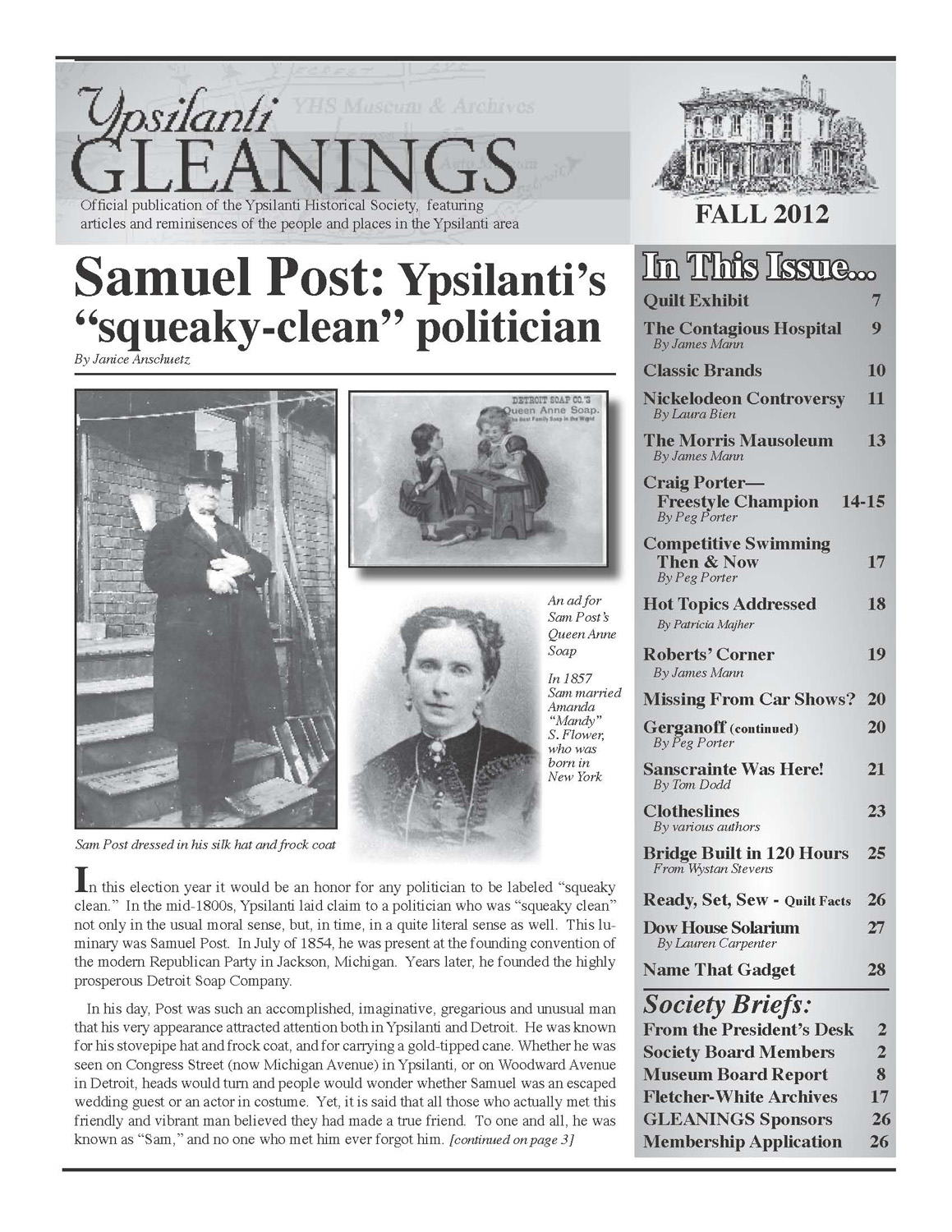
Author: Janice Anschuetz
Samuel Post: Ypsilanti’s “Squeaky Clean” Politician
By Janice Anschuetz
In this election year it would be an honor for any politician to be labeled “squeaky clean.”
In the mid-1800s, Ypsilanti laid claim to a politician who was “squeaky clean” not only in the
usual moral sense, but, in time, in a quite literal sense as well. This luminary was Samuel Post.
In July of 1854, he was present at the founding convention of the modern Republican Party in
Jackson, Michigan. Years later, he founded the highly prosperous Detroit Soap Company.
In his day, Post was such an accomplished, imaginative, gregarious and unusual man that his very
appearance attracted attention both in Ypsilanti and Detroit. He was known for his stovepipe hat
and frock coat, and for carrying a gold-tipped cane. Whether he was seen on Congress Street (now
Michigan Avenue), in Ypsilanti, or on Woodward Avenue in Detroit, heads would turn and people would
wonder whether Samuel was an escaped wedding guest or an actor in costume. Yet, it is said that all
those who actually met this friendly and vibrant man believed they had made a true friend. To one
and all, he was known as “Sam,” and no one who met him ever forgot him.
The Family Background: Samuel Post was born on November 9, 1834, in a brick home surrounded by
gardens, in the middle of what is now the south side of Michigan Avenue, between Huron and
Washington Streets. Livingstone’s History of the Republican Party, written by William Livingston
in 1900, gives us more information about this family: “{Post’s} …parents were William Rollo
Post, a hatter, and Mary Ann Pardee. Both parents were born in New York State, came to Michigan in
1830, and located in Ypsilanti, where they continued to reside until death, both dying in the same
year at the advanced ages of 86 and 87. When they came westward the methods of travel were very
primitive, the Erie Canal furnishing the best means of crossing New York State, and an ox team being
used for the journey from Detroit to Ypsilanti. Mrs. Post’s father, Israel Platt Pardee, was a
Captain in a New York regiment during the Revolutionary War and the more remote ancestors were
French Huguenots who fled to this country to escape religious persecution by the Catholics during
the reign of Louis XVI.”
William Rollo and Mary Ann Post eventually had four children, Lucy Ann Post (1827-1922) and Eliza
Pardee Post (1832-1862), Samuel (1834-1921), and Helen Mary Post (1838-1917).
Samuel’s father William Rollo is best known in Ypsilanti history for building what was
sometimes called the Ypsilanti Follies. According to Harvey C. Colburn in The History of Ypsilanti
(1923), this large four-story building, proposed for a hat factory, was adjacent to the Michigan
Avenue Bridge and called “The Nunnery,” based on its venerable appearance. Before it burned
down in the great fire of 1851, the building was used as a school that began as The Presbyterian
Session House. There are accounts of William’s bravery in trying to save the doors of the
building, while flames fanned around town. William was also a land speculator, and, with his
partner Judge Lazelere, extended the town plat south to Catherine Street in 1857.
Samuel’s Start in Business: William’s propensity for business seems to have been inherited by
his only son Samuel. As a young lad, Samuel made a name for himself as a street merchant selling
apples and chestnuts. Livingstone tells us that “At ten years of age, while attending school, he
was employed by Charles Stuck, in his general store, to work, when not engaged in the school room,
at $2.00 a month….” In an article in The Ypsilanti Daily Press of October 30, 1954, more is
written about Samuel’s early ambitions. “His salary finally was advanced to $6.00 a month, and
at the age of 16, he left school in order to give all his time to business. At the age of 21 he was
earning $50.00 a month and decided it was time to strike out for himself.”
As often happened in Samuel’s life, just the right person came along at the right moment to
help. On this occasion it was an interesting man by the name of Rev. John A. Wilson, who served at
St. Luke’s Episcopal Church. Rev. Wilson lived in Ann Arbor and had no horse, so he walked to
Ypsilanti to conduct services and the business of the church. The elder Posts and their children
were active members of St. Luke’s, and Samuel’s sister Lucy sang in the choir.
Samuel is said to have explained his ambitions to open his own store to Rev. Wilson and to have
asked his advice on how to raise $500 to add to the $500 he had saved from his own small salary. He
was so convincing in his eagerness that the kind Rev. Wilson lent the young man $500 from his own
savings to be paid back, without interest, over the next five years.
The Ypsilanti Daily Press article states: “Post entered into partnership with Robert Lambie, a
man who had learned tailoring in Scotland and together they launched into the dry goods business.
It was successful and later Post sold [his share] to his partner and built the Post Block which
housed the largest general store in town.” The Post Block is situated on the north side of what
is now Michigan Avenue (then Congress Street), between Washington and Adams. In its day, it was
surely one of the most elegant blocks in the county, housing both the famed Opera House and the
glorious Hawkins’s House Hotel.
Family Life and Civic Stature: Samuel’s personal life also prospered during this time. In
1857, he married a beautiful young woman, Amanda “Mandy” S. Flower, who was born in New York.
The couple soon had three children: William Rollo Post, born in 1858; Helen E. Post, born around
1860; and Samuel Post, born in 1867.
In 1865, the young family moved into a large brick home on West Forest near College Place, at the
edge of the campus of the Normal School. Samuel’s parents and his sister Helen, who taught at the
college, lived with them. Samuel had bought the home from a local merchant, Adonijah S. Welch, for
$9,550. With its large lawn and gardens, it was the perfect place to raise a family and also to
entertain and impress others. By this time, Post was considered a man of substance and character,
and one of the most important people in Ypsilanti. He was a warden at St. Luke’s Church and a
prominent and prosperous citizen of Washtenaw County.
A Career in Politics: Several sources, such as the Ypsilanti Daily Press article cited above and
an obituary at the end of Sam’s life, add substance to a Post family legend. It reports that
Samuel was present when the modern Republican Party was formed at its first party convention, in
July, 1854 at Jackson, Michigan, under the spreading limbs of an old oak tree. Samuel was just a
young man at the time, only 20 years old, but keenly interested in politics. At the convention he
met the Republican politician Zachariah Chandler, a Detroit dry goods merchant, who soon became a
helpful friend.
To pursue his ambitions for a political career, Samuel first sold off his share of the dry goods
partnership in 1870, earning a good profit. In the same year, he was elected to the state
legislature, and two years later became head of the Republican Party in Washtenaw County.
We learn more about Sam’s burgeoning political career in Livingstone’s book on the Republican
Party. While in the state legislature, Livingstone tells us, Post “…was Chairman of the
Insurance Committee and of the Committee on Federal Relations. As Chairman of the former Committee
he framed or reported some very important legislation, including the general law under which the
first Insurance Commissioner, Samuel H. Row, was appointed and virtually created the Insurance
Department.” Post was also a member of the State Central Committee and attended many state and
national conventions.
With growing national exposure, and the help of his friend Zachariah Chandler, who knew President
Grant personally, Post was appointed by the President in 1873 to serve four years as the United
States Pension Agent at Detroit. He was subsequently re-appointed by President Arthur, and served a
total of twelve years and ten months in this office.
In a Detroit newspaper article, found in the archives of the Ypsilanti Historical Museum and
dated January 11, 1947, W.K. Kelsey provides interesting additional information about these honored
appointments: “This was considered a fat job; so lucrative, indeed, that the former pension agents
had departed with the funds. Therefore Uncle Sam demanded that the holder of the job post bond in
the amount of $600,000.”
That was a high hurdle even for Sam Post. “He knew he was honest,” Kelsey writes, “but the
temptations of the pension office had been proved great. He consulted his old friend Daniel Lace
Quirk, president of the First National Bank of Ypsilanti – knowing that Quirk was a strong
Democrat and unlikely to help a Grant appointee. But Dan Quirk signed the bond for $50,000.00 which
was a lot of faith in those days. When Sam Post showed Dan Quirk’s signature to other responsible
men in Ypsilanti and Detroit, he had no difficulty raising the rest.”
In his History of Ypsilanti, Harvey C. Colburn sheds even more light on the special credentials
required for the Pension Agent’s job. He quotes Post as saying, “Had Quirk not signed, I doubt
if I could have filed the bond. There were no guarantee companies in those days and the pension
office was in ill repute. Three preceding agents had absconded and bondsmen had suffered. I was a
Black Republican and Quirk a strong Democrat, but Quirk put his name down for $50,000.00” It is
said that, in later years, Sam would stop by the First National Bank of Ypsilanti and joke with the
tellers, asking them if Quirk had $50,000.00 in his account!
From Squeaky-Clean Politician to a Squeaky-Clean Business: Samuel Post’s career as United
States Pension Agent at Detroit came to an end with the election of President Grover Cleveland, who
appointed a Democrat to the position. But this also freed Sam for a new undertaking. Having
distinguished himself as a “squeaky-clean” politician, he now formed a squeaky-clean business,
the Detroit Soap Company. Again, he started out with a partner, Digby V. Bell. But, following the
early death of Bell, the company was reorganized and renamed the Queen Anne Soap Company. At this
juncture, Samuel’s sons, William R. and Samuel, Jr., joined the management. From then on, the
company, located in Detroit, prospered under Sam’s leadership and skills as a salesman.
A Good American Businessman and a Typical Englishman of the Victorian Age: In 1893, at the age of
59, Samuel rented out his beautiful home on West Forest to the president of the Normal College, and
for 45 years it served as the official residence of the college president. In 1938, the home was
torn down and replaced with a new official president’s home. King Hall, a dormitory, was also
built on the site. For many years, Sam’s two beautiful and rare Camperdown elm trees continued to
stand outside King Hall. There they reminded passers-by of the grace and elegance of the stately
Post home, until they finally died of old age over a hundred years after they were planted.
On leaving his home, Sam took residence (presumably with his wife Mandy and sister Helen, though
the records don’t make this clear) at the then elegant Hawkins’s House Hotel on the north side
of Michigan Avenue (then Congress Street). From that location he commuted daily to various
destinations by trolley or train. In a letter written by Carl W. Dusbiber to the Ypsilanti
Historical Society many years ago, we learn something about Sam’s life as an elderly man: “He
was a typical Englishman of the Victorian age. He wore a stovepipe hat, a frock coat and his jowls
were garnished with sideburns…. Mr. Post lived … at the Hawkins House, which at the time was
considered one of the best hostelries round about. He went to the Michigan Central Depot for his
frequent trips to Detroit, he always rode in a carriage…. Sam Post was a very picturesque figure.
And he was friendly and affable. He was on the vestry of St. Luke’s Episcopal…. He occupied a
private pew, indication that he was a very generous contributor. I observed all these things,
because around 1904, I was a choir boy at St. Luke’s and once a month Sam Post and the reverend
gave the boys a jolly party.”
Samuel’s unusual appearance was commented on in the newspaper article by Kelsey: “For 40
years or more, Sam Post was a notable figure in Detroit. Strangers who passed him on the street
stared at him. Who was he? A medicine man from some show? An advertiser of something? A strayed
wedding guest? For wherever he went, Mr. Post was arrayed in a silk hat and a frock coat. Long
after these articles of apparel had become the signs of an extra-formal occasion, Sam Post wore them
to his daily work. It is probable that Mr. Post adopted this garb when he was elected to the
Legislature in 1870, and decided that it was the correct attire for a statesman…. He was in no
sense ridiculous; the costume became him. But it made him a marked man, so that people asked who he
was, and got so they felt they knew him, saluting him and speaking to him as they passed, and
receiving a courteous nod in return. No doubt Sam Post enjoyed this publicity and thought it was
good for Queen Anne Soap, as well as for himself.”
A Pioneer in Creative Sales Promotion: Not only was Samuel’s appearance a good advertisement
for Queen Anne Soap, but he had many ways to make sure that the public knew about, and bought, his
product. Each bar of soap had a trading card inside. These are now common on eBay, and the card
illustrations range from flowers and infants to farmers with moonshine. Another gimmick was that
the soap was sold at a discount by the case to enterprising housewives, who in turn would keep the
coupons inside the case and sell the bars of soap to family and friends. The coupons could then be
exchanged for such diverse items as furniture, lamps, and even a trip on a daily excursion boat to
Cedar Point on Lake Erie! My mother-in-law always proudly displayed her family’s Victorian desk
bought with soap coupons.
Mrs. Addie Murray of Farmington, Mich. wrote about her childhood introduction to Queen Anne soap:
“I was a small girl living in Detroit and my mother would walk with her four children to a spot
known as Campans dock. We would board the Belle Isle ferry and for about ten cents ride all of a
summer afternoon and evening up and down the river with the orchestra playing ‘In the Good Old
Summer Time.’ My first notice of Queen Anne Soap when I learned to read was a mammoth sign
located at the river’s edge, which I saw on the excursions. Then later I remember Mother saving
the wrappers for a new parlor lamp or something.”
Perhaps Post’s most imaginative venture into advertising was at the Detroit Fair and Exhibition
of 1899. Visitors to the fair could smell the tantalizing fragrance of Queen Anne Soap, said to be
the first scented soap, and couldn’t believe their eyes when they saw a full-sized cottage carved
out of a giant block of the product!
Sam’s Last Years and Legacy: After the age of 80, Samuel Post sold the soap company and also
the famed Opera House in the Post Block. The Opera House was never the same after that, and the
Hawkins’s House Hotel was hit by a “cyclone” in 1883 and rebuilt around 1886. The Ypsilanti
Opera House was converted into a movie theater in 1918, which, according to the April 2, 1918 issue
of “The Michigan Film Review,” was called the Forum Theatre. The Forum then became the Wuerth
Theater, which showed silent films and held occasional live shows. The part of the building that
was the Wuerth Theater was torn down in 1959 to provide space for a parking lot.
Samuel Post died in Miami, Florida in December, 1921, and, after a well-attended funeral at St.
Luke’s on North Huron Street, joined his wife Amanda, who had died in 1901, in peaceful rest at
Highland Cemetery on North River Street.
Today, we can remember Sam Post not only for his squeaky-clean conduct as a politician, and the
squeaky-clean product he made at the Queen Anne Soap Company, but as a talented public servant who
was elected to the state legislature, appointed by the governor to serve six years on the Board of
Trustees of the Michigan Asylum for the Insane, and appointed by two United States presidents to
head the United States Pension Board at Detroit.
Sam was also a community activist. He was a life-long member, warden, and supporter of St.
Luke’s Episcopal Church. As reported in the 1908 Book of Detroiters, by Albert Nelson Marquis, he
was also a member of the Detroit Board of Commerce and of the Masonic Order, Knights Templar,
Detroit Post No. 384.
Ypsilanti historians know Sam Post best as a colorful and productive contributor to the city’s
early growth. His Post Block still stands today as a reminder of a creative vision that can continue
to inspire our efforts to make Ypsilanti a more vital and attractive place to live.
(Janice Anschuetz is a local historian who contributes regularly to the Gleanings.)
Photo Captions:
Photo 1: Sam Post dressed in his silk hat and
frock coat
Photo 2: An ad for Sam Post’s Queen Anne Soap
Photo 3: In 1857 Sam
married Amanda “Mandy” S. Flower, who was born in New York.
Photo 4: Sam Post’s father William Rollo Post
Photo 5: Sam Post’s mother Mary Ann (Pardee)
Post
Photo 6: The Post house on West Forest near College Place, at the edge of the campus of the
Normal School
Photo 7: The Post Block with the Opera House and Hawkins Hotel where Sam Post lived as an old
man
Photo 8: The Queen Anne Soap building in Detroit
Photo 9: Sam Post
Jr. went into the soap business with his father and brother William
Photo 10: “Queen Anne Soap –
without an equal as a family soap”