Warren Lewis and his famed Auction Sales Pavilion

Published In:
Ypsilanti Gleanings, Summer 2012,
Summer 2012
Original Images:


Author: James Mann

Warren Lewis started out his career as a circus barker. According to an article in the February 5, 1941 issue of a local paper, “Mr. Lewis’ father, W. H. Lewis, operated a chain of hotels including the famous Follett House and the Oliver House at the Depot. There the circus and show people stopped and early in life Mr. Lewis mingled with them. He joined the John Robinson Railroad Show from Cincinnati when they stopped in Ypsilanti. The shows unloaded and loaded at the Deubel Mills and from his window, Mr. Lewis, then past 15, watched and made up his mind to join them. Mr. and Mrs. Gill Robinson, part owners of the circus, stayed at the Follett House and after Warren was discovered with the show, Mrs. Robinson looked after him in a motherly way. Mrs. Robinson was the daughter of “Wild Bill” Hickok, of Western fame.” Lewis had become disabled at age 11 when he lost his left hand above the wrist.

According to other sources Lewis not only traveled with circuses all over the United States but also spent considerable time in Europe with the Barnum and Bailey Circus. According to an article in the October 30, 1954 Ypsilanti Press, “His happiest days were those with the Barnum circus where, as chief barker, he road atop the leading wagon in the old time parade and warned, “Watch your horses, the elephants are coming.’” Lewis married one of the “best bareback riders of her day” and together they owned “Hamptons Great Empire and Warren Lewis’s Two Ring Circus.” The show consisted of two railroad cars when they started out but in 1917 when he sold the show it consisted of 22 railroad cars.

Today Warren Lewis is best remembered as the manager of the Lewis Horse Exchange, a gambling den he operated in Depot Town during the early years of the 20th Century. Gamblers rode the Interurban from Detroit during the racing season to place their bets on the races. This activity received a great deal of attention at the time, until it was closed by order of the governor in 1911.

Yet during his lifetime Lewis was best known for his skills as an auctioneer. He may have been the first to sell an automobile at auction. It was said, if there was anything he had not auctioned a new addition of the dictionary would have to be issued to include it. Lewis resided at the house at 204 North Street, and owned a large tract of land around the house. This property was bounded by North Street, the Michigan Central Railroad sidetrack on Lincoln Ave. and Babbitt Street. On this property Lewis announced he was planning to build an auction sales pavilion. “The sales pavilion will be built adjoining the Michigan Central sidetrack which passed over Mr. Lewis’ property. This insures the best of shipping facilities for those who will send stock here to dispose of at auction and to buyers who may wish to ship out their purchase,” reported The Ypsilanti Daily Press of Saturday, March 21, 1908.

“The pavilion will be built with glass sides and wholly enclosed,” continued the account. “The seats will be amphitheater style with a ring as in a circus where the stock will be in plain view of everyone when it is under the hammer. There will be an auctioneer’s stand and cashier’s desk. The sales will be conducted summer and winter and in order to make it thoroughly comfortable in cold weather, the pavilion will be equipped with a steam heating plant. There won’t be anything small or cheap about the whole affair. It is designed to be one of the auction centers of the country and a leading attraction of the city.”

The pavilion was principally designed for the sale of horses and cattle. “I propose to pull off some of the big farm auction sales there too,” said Lewis. “It will be central and farmers can bring in everything they have to offer.”

The auction sales pavilion must have been a success, as Lewis added a second pavilion some twelve years later. “The new pavilion has a Michigan (Central Railroad) siding and loading shoot and about 8,900 feet of floor space and will accommodate 20 automobiles or vehicles, large consignments of house furnishings, general merchandise, and will be an excellent place for holding stock sales,” reported The Ypsilanti Record of Thursday, April 22, 1920. “It faces the D. U. R. tracks (Interurban) on Michigan Avenue and will also serve the farmers who wish to dispose of their farm products of live stock, or farm machinery which they wish to bring for private or public sale, with little or no expense to them, in fact, they can advertise and conduct their own sale.”

Lewis was known throughout the United States and Europe for his auctioneering skills. M. Cummings, editor of a big auction journal in Chicago published the following comments: “America has had many really great auctioneers who have made fame and fortune usually specializing in some particular line of sales. Warren Lewis is the greatest all around auctioneer on earth. The reason for this is he can become an expert on any kind of a sale, selling on a few minutes’ notice. Our files in this office show that he specialized with the top liners for several years before he stepped out in the champion class of all around auctioneers and is now in a class by himself. Besides conducting larges sales Warren Lewis is an instructor in the art of auctioneering at his large home auction studio in the college city of Ypsilanti, Michigan. The writer is thinking that if anyone can give fundamental principles and teach auctioneering in all its branches Warren Lewis is the man.”

Lewis sold the auction grounds to the Ward Company of Jackson on Friday, May 28, 1937. The new owners planned to remodel the buildings and set up a buying and shipping business. “The grounds have been a landmark for many years,” noted The Ypsilanti Daily Press of Friday, May 28, 1937, “and many deals, starting with horses in former days and progressing to automobiles in recent times have been transacted.”

Today there is nothing of the auction pavilion to be seen. All that remains is the house where Lewis once lived.

(James Mann is a local historian and author, a regular contributor to the GLEANINGS, and a volunteer in the YHS Archives.)


[Photo caption from original print edition]: Warren Lewis enjoyed the attention he received because of his jaunty attire and the fact that he usually carried a cane

[Photo caption from original print edition]: The Warren Lewis Auction Sales Pavilion was located at 204 North Street where he owned a large tract of land around the house

Peck Street: A Story of Broken Dreams!

Published In:
Ypsilanti Gleanings, Fall 2011,
Fall 2011
Original Images:


Author: Janice Anschuetz

All that remains of the hopes and dreams of a family of 19th century English immigrants to Ypsilanti is a brick building, used as a garage since the 1920s, and an adjoining brick wall. If those remaining structures could talk, they would tell an interesting and sad tale of misfortune that must sound familiar to many investors and business people today.

The small garage, now standing about 100 feet east of the old historical home at the northeast corner of River Street and East Forest, started life as the second school founded in Ypsilanti. Built in 1839 by Joseph and Sophia Peck, and named the Peck Street Primary, it was situated a small distance across from the original Peck homestead built in 1824. The Peck home was located on what was then called Peck Street, now a driveway off North River on the property of the historical home later constructed there.

Reportedly, Sophia Peck had served as a “school marm” in the Pecks’ native state of New York, and, believing in the value of a good education, had encouraged her husband to build the school in Ypsilanti. As it happened, the Peck Street Primary flourished, and in 1850 it was sold to the 4th Ward School District for $40. It then became one of the first “graded” schools in Michigan, which meant that students attending it advanced from grade to grade based on performance standards, rather than simply using textbooks to learn skills at their own pace. By 1866, the small graded school was bursting at the seams with 99 pupils, and the school board decided to replace it with a larger four-room building at the corner of Prospect and Oak. That new school, named the 4th Ward School, was eventually built in 1878.

The story of the original Peck Street Primary continues with a man named George George, who had immigrated with his family to Ypsilanti from Kent, England in 1863. George purchased the defunct Peck Primary and, with the help of his son Worger George and son-in-law Leonard C. Wallington, converted it into a small malt house. Ypsilanti was home to several breweries at the time, and malt was essential to the industry. It was made from barley bought from nearby farmers, which was sprouted in the malt house, with the help of steam equipment, and dried. The resulting malt was then supplied to the breweries, where it was combined with yeast, hops, and other constituents as a basic ingredient for brewing fine beer.

A further turn in the story came with the arrival of a visitor to the George family from the town of Dorset, in Kent, England. This was a “cousin” of sorts by the name of Frederick John Swaine, who had come to the United States to “seek his fortune.” Taking a shine both to Ypsilanti, and to the daughter of George George, a young beauty named Eliza (called Lizzie), Swaine decided that this was the place he wanted to stay and invest his inheritance. He married Lizzie in 1874, became a partner in the malt business with her family, and built a fine home just west of the malt house. That home is now proudly occupied by the writer of this piece and her husband, nearly a century-and-a-half later.

From Orphaned Baby to Successful Businessman and “Father of Classical Music in Michigan”

Frederick Swaine was orphaned as a one-year-old baby and raised by relatives in Kent, England, where he was well educated. He spent part of his childhood living with an uncle in a palatial homestead -- Lympne Castle, near Romney Marsh, in Kent. His father and grandfather were considered to be among the finest brewers in Great Britain, and had been licensed for several generations to brew beer for the royal family. It was no wonder, then, that young Frederick found himself drawn to the George family and their malting business. In them he could make real his dreams of winning his fortune in America.

After their marriage, Frederick and the former Lizzie George moved from the George/Wallington residence at 627 North River to their fine new home at what is now 101 East Forest. There they soon became pillars of Ypsilanti’s gentile society. Frederick bought out his partners in the malt business and greatly enlarged the malt house. The new structure, which measured 50 x 94 feet and was three stories high, now fronted East Forest Avenue rather than Peck Street. What had once been the entire Peck Street Primary had become the steam room for the malt house. On stationary and business cards, Frederick Swaine presented himself as “Maltster and Dealer in Barley, Malt and Hops.”

The Swaine business thrived. With his savvy, drive, and investment capital paving the way, Frederick increased the sales of beer grains from 11,000 bushels in 1874 to 40,000 by 1880. In addition, his education, talents, and interests added much to the growing Ypsilanti community. He became a good friend of Frederick Pease, who founded the music program at the Normal College (now Eastern Michigan University). The relationship was so close that, after Pease had carefully selected a fine rosewood square grand piano for the Normal school, Frederick Swaine purchased an identical one for the parlor of his home. [That piano has since been restored by the present owners of the home and still stands in the same parlor in all its original stately grace.] By the end of his life, Swaine’s influence on the music program at the Normal College, his patronage of local concert halls, and his various roles as a gifted actor in Gilbert and Sullivan plays in the Ypsilanti Opera House had brought him such recognition that he was characterized in his obituary as “The Father of Classical Music in Michigan.”

The Dreams are Shattered

Regrettably, as we see happening all around us today, economic vicissitudes have a way of shattering the dreams of even the best businessmen. Frederick Swaine would come to suffer the same fate in his day.

His malt business continued to thrive until the mid-1890s. But its future was always uncertain, since it depended on the willingness of local breweries to pay a price for his products high enough to cover the costs of the barley and hops he bought from farmers, and still allow a profit.

In Frederick Swain’s case, it happened that, when his huge three-story malt house had been gorged with produce purchased with money borrowed from the Ypsilanti Savings Bank, a supplier in Kansas City, Missouri offered the breweries in the area grain products at a price three cents a bushel less than Frederick could sell them for. The breweries quickly changed suppliers and left him in dire economic circumstances. He had borrowed heavily from the bank to fill the malt house, and now found himself $16,000 in debt. He died suddenly soon afterwards, without a will, in April, 1897.

Swaine’s obituary tells us much about his death, as well as his life. The cause of his death at the age of 47 is cited as “nervous prostration.” This was a Victorian term for a nervous breakdown, which was then thought to have a physical basis as a “disease of the peripheral nerves.” Most likely, this successful young man died from great frustration and worry caused by his inability to figure out a way to save his home, business and family from a weighty burden of debt.

In the obituary, which was published in the local papers of the time, Frederick is described as an honest man, well read, interested in politics, charitable, an initial organizer of the Ypsilanti Musical Union, choir director of the German Lutheran Church, an actor and singer, a student of the German language, and a devoted husband and father. The obituary states that “While Mr. Swaine has not been well for months, he did not finally give up until the Sunday before his death, at which time it was found impossible to build up the nervous system. Nervous prostration, resulting in congestion of the brain, was the immediate cause of death.”

The Ypsilanti Savings Bank appointed its own Robert Hemphill as administrator of the heavily indebted estate. Hemphill quickly published a newspaper article indicating that he would continue to operate the business of buying and selling grains for brewing. “As administrator of the estate of the late Frederick J. Swaine,” Hemphill wrote, “I am requested by the heirs of the estate to say that the business of buying barley and manufacturing and securing malt will be continued by me for them, so that parties having barley to sell can depend on getting the highest market price at the old stand, corner of Forest and River street, Ypsilanti, and orders for malt will at my hands receive prompt attention, and customers may depend on the same courteous treatment in the future as in the past.” This newspaper article was dated one week after Swaine’s death – April 21, 1897. The business continued under Hemphill’s supervision until November, 1904, when it was “closed out” with the sum of $4,000 still owed to the bank.

This sad story of broken dreams continues with a court case against Robert Hemphill brought by Frederick’s widow, Lizzie, and his two daughters. The women argued that the amount of $4,000 supposedly owed the bank was fraudulent and should be set aside. They contended that Hemphill either should have sold the business when Frederick died or run it year by year only if there were a profit and not a debt. The case eventually went to the Michigan Supreme Court, where, on May 8, 1911, its opinion was rendered and published.

The summation of the case indicates that Mrs. Swaine put the entire amount of the insurance money granted to her after her husband’s death - $5,650 – into the business, and, further, that the business paid out to her and her daughters nearly $9,500. It also notes that men employed at the malt house did work at the Swaine home and that the home was heated by the malt house (probably excess steam). The judges determined that the Swaine women and Mrs. Swaine’s brother were aware that the business had lost money in the fourth year, but were part of the decision making process to continue to operate the business, along with Hemphill, and so they were equally culpable in the loss.

The published decision in the case states that “the losses during the latter part of the operation appear to have been caused in part … by competition with large manufacturers of malt, who sold at prices so low that this small plant could not make a profit of it .…” It further describes the widow’s efforts to save the situation: that she daily traversed the one-hundred feet from her home -- which she was in danger of losing to the bank -- to the malt house, in order to inspect the books, and that she had asked her brother, also in the malt business, to come from Kansas City to try to help save the business and the livelihood it provided. Nevertheless, the Supreme Court decision denied both the case brought by the Swaine women, and any claims made by Swaine’s widow, in favor of Robert Hemphill, who had once been a friend of the family.

In an insurance map of 1909, we find that the building that had originated as the Peck Street Primary and then become a malt house is in use as a storage area for ladders – probably by the nearby ladder company on East Forest Ave. In 1912, the same property, then owned by a carpenter, George Jackson, was torn down, except for the part that was the original Peck Street Primary, and the bricks sold and used to build the interurban barns on Michigan Avenue near River Street. The two lots on which the expanded malt house once stood were sold, and Sears and Roebuck homes were built on them by the Lidke and Bortz families. In a final change, what was once the Peck Street Primary school, which educated hundreds of Ypsilanti children, was turned into a garage, and a brick wall now defines what had been the west wall of the building.

Frederick Swaine’s widow Eliza and her two daughters, Florence and Jesse Swaine, were able to save their home and enjoy it for the rest of their long lives. Jesse died in the same room and bed in which she had been born some 89 years earlier. Both daughters, who grew up on the same property as the Peck Street Primary, became teachers and influenced many a young life in Ypsilanti, Wayne and Detroit, helping make good on the vision of Joseph and Sophia Peck when they first opened Ypsilanti’s second school.

The son of Worger George (Frederick Swaine’s brother-in-law and former business partner), Edward Shutts George, was also interested in education and served on the Ypsilanti School Board for many years. George School, on Ecorse Road, is named for him. As a child, Edward would have played with his cousins, Florence and Jesse Swaine, at the site of the Peck Street Primary, which had been founded in 1839 to provide a basic education to children in the frontier wilderness of Ypsilanti.

If buildings could talk, the modest brick structure that still remains about 100 feet east of the Swaine House at Forest and River – though three walls have fallen down and been replaced, and it now serves only as a prosaic garage -- would have a poignant story to tell. Hearing it, we could surely learn even more about the hopes and dreams of English immigrants to the new world, and of fortunes won and lost.

(Janice Anschuetz is a local historian who is currently researching and writing her third book – a history of one of her ancestors and their role in the shaping of England and America.)

PHOTO CAPTIONS:

Photo 1: Peck Street Primary at the left with the daughters of Frederick Swaine’s partner, L. C. Wallington – Maude and Ethel May, with Florence Swaine on the right

Photo 2: Maude and Ethel May Wallington outside the Malt House in the snow

Photo 3: The Malt House fronting East Forest. Worger George in front with a shovel

Photo 4: Eliza (George) Swaine

Photo 5: Frederick Swaine

Photo 6: Lympe Castle and Church in Kent where Frederick Swaine grew up as a boy

Photo 7: Malt House connected to Peck Street Primary. Part of the West wall remains as a brick wall today, as does the Peck Street Primary. This shows the first cement sidewalk in the City of Ypsilanti that the town cows liked to walk on while going to pasture at the river

Photo 8: Florence and Jesse Swaine and friends outside the Malt House in a donkey cart.
The Swaine house is to the left

Local Historic Districts

Published In:
Ypsilanti Gleanings, Summer 2011,
Summer 2011
Original Images:


Summer 2011

Author: Michael R. Newberry

Local Historic Districts
By Michael R. Newberry
Local Historic Districts are a point of pride in a community. Neighborhoods in a local Historic District tend to maintain property values better than comparative neighborhoods located outside of the Historic District. Because they are often comprised of residents concerned with the preservation of examples of quality workmanship and construction, and because they are guided by a commission that upholds standards provided by The Secretary of the Interior, Historic Districts often look better and possess a more unified community than surrounding areas. Residents are rewarded for approved home improvements through State and Federal Tax Credits for Rehabilitation, and pleasant-looking, unified communities often experience lower crime rates in their area as a result.

Ypsilanti currently has the third largest Historic District in Michigan, and this city possesses many examples of valuable architecture within and outside of its current Historic District boundaries. Current neighborhoods within the Historic District include the Historic South Side Neighborhood, the Historic East Side Neighborhood (including Depot Town), Downtown Ypsilanti, and the Riverside Neighborhood. There are many houses and neighborhoods of historic merit that exist outside of the current Historic District, that currently do not receive all of the benefits that are experienced within the District. If Ypsilanti were to consider the creation of four additional Historic Districts, more beautiful neighborhoods could receive these valuable benefits, which could arguably increase the desirability of Ypsilanti, Michigan for home ownership.

Four Ypsilanti neighborhoods possess character traits that would make them excellent candidates for additional Local Historic Districts. Midtown Neighborhood, Woods Road Neighborhood, Normal Park Neighborhood, and College Heights Neighborhood possess unique characteristics that would make them valuable assets to the community as individual Local Historic Districts. Because Local Historic Districts must establish a period of significance, each neighborhood benefits from a focused range of years considered historically significant in their particular neighborhood. This reinforces the notion that all historic homes have the same merit, because they fall within a time period significant to our local, state, or national history. Thus, a ranch house from the 1950s is just as important and worthy of preservation as a Greek Revival farmhouse from the 1840s.

Furthermore, if the current Local Historic District were to be divided into its component parts, and each neighborhood association currently within the District were considered its own Local Historic District, such an act would serve to encourage partnerships with the individual neighborhood associations and its community members. Such partnerships would aid in the dissemination of information in an effort to educate the community, and it would help further market and define each neighborhood in its own unique way. Essentially, each Local Historic District (neighborhood association) would be in compliance with a basic set of standards, but they would also have their own tailored standards that meet their unique, architectural, and aesthetic needs. Such standards would also enable the Historic District Commission to better serve the community because they would be able to narrow their focus to standards that are tailored to a specific neighborhood. For example, the needs of a homeowner seeking to renovate a 1950s ranch house are very different than the needs of a homeowner renovating an 1860 Italianate home. Effective communication and direct guidance could be provided by the Historic District Commission to homeowners in distinctly separate Local Historic Districts.

Granted, much footwork would have to be done to establish these new Local Historic Districts, but much footwork has already been done. Graduate students at Eastern Michigan University’s Historic Preservation Program documented and photographed much of Normal Park and College Heights in the mid 1990s. These documents have been preserved and are available to the public here in the Ypsilanti Archives, waiting to be compiled into a report that would advocate for the creation of a Normal Park Historic District and a College Heights Historic District. Below are small overviews of each of the four neighborhoods that would make ideal Local Historic Districts. Each overview contains a map of the neighborhood boundaries along with an example of the different house types encountered in each neighborhood.

Midtown Neighborhood: Nestled south of Eastern Michigan University and west of downtown Ypsilanti, Midtown Neighborhood is the oldest of the four neighborhoods that could be proposed as a Local Historic District, and it is largely composed of homes from the Victorian period. The Midtown Neighborhood Association is bounded on the South side by West Michigan Avenue, on the East side by North Hamilton Street, on the North side by Washtenaw Street, and on the West side by Summit Street.

Woods Road Neighborhood: Woods Road Neighborhood is comprised of 46 houses located on Linden Court, a cul-de-sac directly south of Recreation Park, and the rectangular diverticulum of Woods Road and Pleasant Drive. The majority of the houses in this neighborhood are wood frame structures from the 1930s. There are also masonry and stone houses in various revival styles to include one English Medieval Revival designed by Ralph S. Gerganoff. Linden Court is comprised almost entirely by wood framed English Tudor Revival homes.

Normal Park Neighborhood: Approximately 700 houses comprise the Normal Park Neighborhood Association. Known for its 1920s and 1930s Colonial Revival homes, various kit homes, Bungalows, Craftsman, and English Tudor Revival homes, Normal Park is a unified community with many excellent examples of highly maintained historic homes. The neighborhood is bounded on the South side by Congress Street, on the East side by the west side of Summit Street, on the North side by the south side of Washtenaw Avenue, and on the West side by Mansfield Street.

College Heights Neighborhood: The newest of the four neighborhoods that should be proposed as a Local Historic District, College Heights is known for its post-war ranch style homes and English Tudor Revivals. This neighborhood was among the first in Ypsilanti to abandon the grid system in favor of the non-linear neighborhood street layout reminiscent of 1950s suburbia. College Heights is bound on the South side by the north side of Washtenaw Avenue, the East side by Oakwood Street, the North side by Ainsley Street, and the West side by Bellevue Street. The proposed Local Historic District boundaries for College Heights might be bounded as it existed in 1952: on the South side by the north side of Washtenaw Avenue, the West side by Cornell Road, the North side by Collegewood Drive, and the West side by the east side of Oakwood Avenue.

(Michael Newberry is a graduate student in the graduate program in Historical Preservation at Eastern Michigan University. He just completed an Internship in the YHS Museum.)

Photo Captions:

Photo 1: The current Historic District in Ypsilanti is the third largest in the state of Michigan.

Photo 2: The Midtown Neighborhood is south of Eastern Michigan University and west of downtown Ypsilanti.

Photo 3: The Midtown Neighborhood is composed mostly of homes from the Victorian period.

Photo 4: The majority of the houses in the Woods Road Neighborhood are wood frame structures from the 1930s.

Photo 5: There are masonry and stone houses in the Woods Road Neighborhood in various revival styles including thisEnglish Medieval Revival designed by Ralph S. Gerganoff.

Photo 6: The Normal Park Neighborhood is known 1920s and 1930s Colonial Revival homes, various kit homes, Bungalows, Craftsman, and English Tudor Revival homes.

Photo 7: This home at 311 North Wallace Boulevard was built in 1921.

Photo 8: The College Heights Neighborhood is known for its post-war ranch style homes and English Tudor Revivals.

Photo 9: This home at 703 Cambridge Street was built in 1952.

Famous Ypsi Fence Trial

Published In:
Ypsilanti Gleanings, Spring 2010,
Spring 2010
Original Images:

Author: James Mann

As we come into a new age of urban farming, the keeping of farm animals such as chickens, goats and cows on city lots, we must consider the legal issues that arise. For example, will urban farmers be libel for damages done by their animals to the neighboring properties? To find the answers, we must seek guidance from the past. The question arose in 1920 in Ypsilanti Township.

Every farmer who lived near William Gotts and John Lewis attended the session in the Ypsilanti Town House on Wednesday, February 25, 1920. That was the day Justice D. Z. Curtiss heard the case between the two. There was great interest in the case as an important issue was involved – “does the Huron River make a good fence line?”

The road to the Town House was crowded with automobiles and cutters. The benches and seats were filled with farmers and their help. The wives of Gotts and Lewis graced the occasion with their presence. One of the wives spent her time in the session making fancy edging for lingerie.

“Some were in overalls, some were in hunting corduroy suits, some had overcoats, but more dispensed with this necessity for city life. One man came with an overcoat made form real buffalo skin, but showing at least 60 years or more of wear. Pants were tucked in boots, and in one instance, the owner of a fur cap forgot the formality of removing it while the court was in session,” reported The Daily Ypsilanti Press of Wednesday, February 25, 1920.

“The sign, ‘No Smoking,’ was absent,” continued the account, “so quite a number of those present indulged in the luxury of a pipe or a cigarette. And as the testimony proceeded, the loud laughs broke the monotony of the proceedings when some witness was describing the unruliness of the cattle owned by the defendant.”

Justice Curtiss knew his audience, and had hunted up a wooden spittoon and placed it in a convenient spot. He also had chairs moved from behind the railed off part of the room, and placed near the center. There were also chairs placed close to the great cast iron stove, which was the source of heat on this winter day.

The suit involved a bill of $56 for damage done to corn, potatoes and fodder destroyed by cattle owned by John Lewis. It seems the cattle of Lewis persisted in breaking down a fence or wading across the Huron River to get at the crops of William E. Gotts. Testimony brought out that Lewis had settled once before with Gotts for damages, when his cattle broke through the fence on a previous occasion. He did not deny the further damages done by his cattle, but did question the amount of damage done. Lewis, having paid Gotts damages once, considered the matter settled and felt he should not be expected to pay for further damages by the same cattle. He felt he had fulfilled his obligation. In the end, Justice Curtiss did not agree, and awarded Gotts $51 and costs.

“The case is typical of the frequent claims for damages that arise among farmers for the breaking in of neighboring stock,” wrote Justice Curtiss in his decision, which was published by The Daily Ypsilanti Press of Saturday, February 28, 1920, “and injuring and destroying crops. Usually, as in this case, inefficient fencing plays an important part in the trouble.”

“There is a statute restraining the collection of damage done when the complainant has failed to maintain a legal fence,” noted Justice Curtiss, “But the testimony shows that neither party had a legal fence, so the court took the view that the cattle broke in across the line of both parties, and Lewis is stopped from availing himself of the statute.”

Curtiss thought it doubtful Gotts could legally recover the time and effort spent in driving the Lewis cattle from his property, and dropped the $5 car charge from the bill.

“No person,” concluded Curtiss, “is bound by common law to fence against the beast of another, but owners of beasts are liable for any damage done by them on the lands of another.” The Ypsilanti Fence case was settled.

(James Mann is a local author and historian, a volunteer in the YHS Archives, and a regular contributor to the Gleanings.)

The Orange Lantern

Published In:
Ypsilanti Gleanings, Winter 2009,
Winter 2009
Original Images:

Author: James Mann

For many years, from the end of Prohibition until the year 2000, the Orange Lantern was a popular Ypsilanti landmark, even if it was just across the county line in Van Buren Township. Named for some light fixtures inside, the Orange Lantern drew its clientele from the factories, foundries and tool-and-die shops in the Ypsilanti area. At times the place was so crowded each patron who was coming in had to wait for someone to leave. This was a neighborhood bar, the kind of place where a guy stopped by for a beer while on the way home from the factory job. That may be why it was so popular for so long.

The Orange Lantern opened in 1933, just after the repeal of Prohibition. It was one of the first bars to be granted a liquor license. Then, the land around the Orange Lantern was soybean fields and maple sugar woods. Back then, the Orange Lantern was the last stop for liquor by the glass until Indiana.

During World War II liquor rationing for bars was set by the amount sold before the war, and, it is said, the Orange Lantern had the largest liquor ration in the state. Workers from the Willow Run Bomber plant, where the B-24 Liberator was built, enjoyed the friendly atmosphere of the place. The war years were the heydays of the place, when workers from the plant found it a convenient place to unwind. The regular clientele, it is said, included the woman who was the model for Rosie the Riveter.

The bar was run for years by Bill Eberts, and then for years after by his son, Dick Eberts and Bud Fahndrich, a nephew. Dick Eberts worked at the bar from the age of 18, with four years out for service in the army during the World War II. “It’s my life,” he told the Ann Arbor News for a story published on September 1, 1996. “It’s meeting new people and experiencing different things.”

Over time the number of customers declined, and no one had to wait for someone to leave before they could enter. Still, the regulars came and new ones stopped in. It was a place where everyone knew most everyone else. Dick Eberts died at the age of 83 on October 15, 1999. Fahndrich vowed to keep the Orange Lantern open, and did so for the rest of his life. He died in December of the same year. The doors of the Orange Lantern were closed and the lights turned out for the last time on February 4, 2000. The place is gone, and the memories are fading.

(James Mann is a local historian and author, a volunteer in the YHS Archives and a regular contributor to the Gleanings.)

Photo Captions:

Photo 1: The Orange Lantern neighborhood bar that opened in 1933 and closed in 2000 (Photo by Jim Rees).

Dutch Town Ypsilanti Michigan, USA

Published In:
Ypsilanti Gleanings, Summer 2004,
Summer 2004
Original Images:


Author: Doreen Binder

My family has fond memories of growing up in the “Dutch Town” area of Ypsilanti during the 1930s and 1940s. The neighborhood borders River Street to the west, Babbitt to the north, Grove on the east, and South Street to the south with Michigan Avenue cutting right through the middle. Other streets included Parsons, Lincoln, and Park. Dutch Town is now included in an area called South Depot Town.

Woodruff School, at the corner of Michigan and Park, was a local landmark. Floyd Smith was the well loved principal who cared for his students as family. Floyd was an effective role model for the boys in the school. Louella Parsons, Esther Fletcher, Jane Holzhauer, and Amy Hopkins Thomas were some of the wonderful teachers. Derwood Hagen, the Poling girls, and Bob Russell were some of the alumni. Derwood now serves as an election worker at the Adams School poll.

Businesses on the north side of Michigan Avenue going east from River Street started with Ken Brokaws gas station on the corner now occupied by Al Robinson's fish restaurant. Ken later opened Ken's Bar in Depot Town. Continuing east, Dolph Thorne's Tire and Appliance store was on the site of Lucas Restaurant, followed by the A & P store on the northeast corner of Grove and Michigan. Marsh plating is now located on that corner.

On the south side of Michigan, early businesses included Otis Tooze's Barber Shop, Herzberg's Processing (we called it a junk yard, modern jargon would call it a recycling center), Steffes Gas Station, Russell's Bakery, and C.F. Smith's Grocery on the southeast corner of Park and Michigan. Parkview Pharmacy occupied what is now the party store on the south side of Michigan Avenue. My dad, George Binder, partnered with Bernard Mcllhargie and bought the pharmacy. The pharmacy was locally called Mcllhargie & Binder Drugs where I spent many hours serving sodas and helping dad. Later, John Kealy's Bakery replaced Russell's Bakery. John's glazed donuts were memorable. Additional businesses included Al Holzhauer's Print Shop, Max Bitker's Dry Goods, and Emil Batchelor's Meat Market where neighbors bought fresh meat daily. What is now the Bomber Restaurant was started by the Baldwin family and was known as Mrs. Baldwin's Restaurant. During World War II, the family changed the name to the Bomber. The house that stood to the east of present day Al's Barber Shop was Clarence Tyrell's Plumbing Shop. Clarence taught his customers how to do repairs and he had every plumbing part a customer could ever need that only he could find. Clarence even made labor free house calls for his Dutch Town neighbors. This plumbing shop building recently burned and was demolished as a consequence of the fire. Carrie Chadwick's Piano store occupied the southeast corner of Grove and Michigan where the Mida's Muffler is now located.

In 1935, a State Police Post was erected on the southwest corner of Michigan and Park. The first commander was Frank Walker. The good looking troopers brought a new look to the area. The building recently was a rug market and will be demolished as part of the Water Street development. Gilbert Park, on the south side of Michigan Avenue and between Park Street and the railroad track, was the center of summer activities for the neighborhood kids. There were band concerts in the summer as well as supervised playground activities.

Summer ended with a “friendly” tournament with kids from all the city supervised playgrounds competing. Gilbert Park was sold by the City of Ypsilanti for an Arlans Department Store development in the 1960s. The park will be remembered as Gilbert Square when the Water Street project is completed.

Dutch Town families included the Thumns, Beggers, Harners (Ev, Harp, & Win), Horns, Hipps, Reddaways, Hinschs, Croghans, Parkers, Thibodeaux, Mayos, Malcolms, Hines, Tuckers, and others. With his automotive dream, Preston Tucker became the most famous Dutch Town resident. In an earlier issue of the Gleanings, Bob Mayo told his fond memories of delivering newspapers around Dutch Town. Carl Hipp grew up on Michigan Avenue between Park and Grove and was always eager to share his stories of the area. Carl moved up near North Congress and Wallace and recently died in his late nineties.

Within the small town of Ypsilanti, Dutch Town was a distinct community. The local businesses provided all of the needs and services a family could want. The families gave me warm memories of my childhood. As is the same story everywhere, the small businesses lost out to supermarkets and large chain stores. With the loss of businesses, Dutch Town lost its identity and is only remembered by us old timers.

Photo Caption: Doreen Binder in front of the drugstore
Photo Caption: Gas Station
Photo Caption: Woodruff School, Ypsilanti, Mich.
Photo Caption: Gilbert Park, Ypsilanti, Mich.

The House at 220 North Huron Street

Published In:
Ypsilanti Gleanings, Autumn 2001,
Autumn 2001
Original Images:


Author: James Mann, Museum Historian

When Judge Augustus Brevoort Woodward plotted the village of Ypsilanti in 1825, he intended for Huron Street to be the ‘Gold Coast’ of the community. The avenue where the rich and powerful lived, on a street lined with splendid houses. This was to be the part of the city, that would tell visitors, that this was a city with a future.

The house at 220 North Huron certainly conveyed that message. This Italianate structure was built in 1860 by Asa Dow. Dow had come to Ypsilanti not long before with Daniel L. Quirk, with whom he had been in business with in Chicago. Dow came to Ypsilanti with Dow in 1860 and had the house built that same year. The town moved quickly into the business life of the community. The stockholders of the newly formed First National Bank of Ypsilanti elected Dow President at their first meeting on December 15, 1863. Dow was also an incorporator of the Ypsilanti Woolen Mill.

“There are few placed of its size that can boast of as many beautiful private residences as Ypsilanti,” noted The Ypsilanti True Democrat of Friday, April 22, 1864. “Many of them have handsome lawns and gardens, tastefully decorated with ornamental trees, shrubbery and flowering plants and not a few possess an ornate style of architecture for an inferior city… The dwellings of Messers Dow, Jenness, Samson, Mills Loveridge and Major Atwood are all elegant and tasty domicile's and worthy of attention.”

What ever pleasure Mr. Dow may have felt at reading such words, it did not last long. His wife Minerva died on July 12, 1864 at the age of 37 years, 3 months and 3 days. She was the second person buried in Highland Cemetery.

Mr. Dow, perhaps because of grief, sold his house to Aaron Goodrich for $14,000 in March of 1865. The price of purchase included the household goods. This was a huge amount for Goodrich to pay, at a time when a respectable home sold for less than $5,000.

After the house was sold, Dow returned to Chicago, where he was active in business. He married and fathered two children. Dow died at Chicago on September 23, 1890. His body was brought back to Ypsilanti, and he is buried in Highland Cemetery in the grave next to Minerva.

At the time he purchased the house, Aaron Goodrich was the manager of the Follett House hotel on Cross Street. He quit after two years, to become a salesman for Batchelder & Company Monument Works, a local marble works. Still, Mr. Goodrich seems to have taken good care of his house.

“A handsome fence—Messers A. H. Goodrich and D. L. Quirk are enclosing their residences on Huron Street with new fence that is indeed a credit to our city,” reported The Ypsilanti Commercial of Saturday, May 13, 1865. “It is mainly of wood but molded and sanded to imitate iron. It has elegant iron gate posts and is bolted with iron clamps to large square stone posts sunk three feet into the ground. For durability, it cannot be surpassed and we have seen nothing so tasty. We are told its cost was $30.00 per rod.”

Goodrich moved to Saline in 1875, to open the Goodrich House. He sold the house on Huron Street to Lambert Barnes. Barnes was the President of the Peninsular Paper Company, and served as Secretary and Superintendent of the company. Barnes was elected mayor of Ypsilanti in 1875, the same year he moved to the city. He seems to have taken good care of the house. “This property,” noted Portrait and Biographical Album of Washtenaw County, Michigan, 1881, “may well be called one of the finest homes in the city.”

He had a striking resemblance to President Ulysses S. Grant, with whom he was sometimes mistaken. Barnes died on June 20, 1887 in Detroit, where he had gone to treatment of an ulcerated tooth. At the time of his death, Barnes was the Vice-president of the First National Bank of Ypsilanti, the same bank As a Dow had founded. Jane Barnes, the widow of Lambert, remained at the home until her death on July 9, 1893. The house remained in the Barnes family until it was sold to Laverne Ross in 1922.

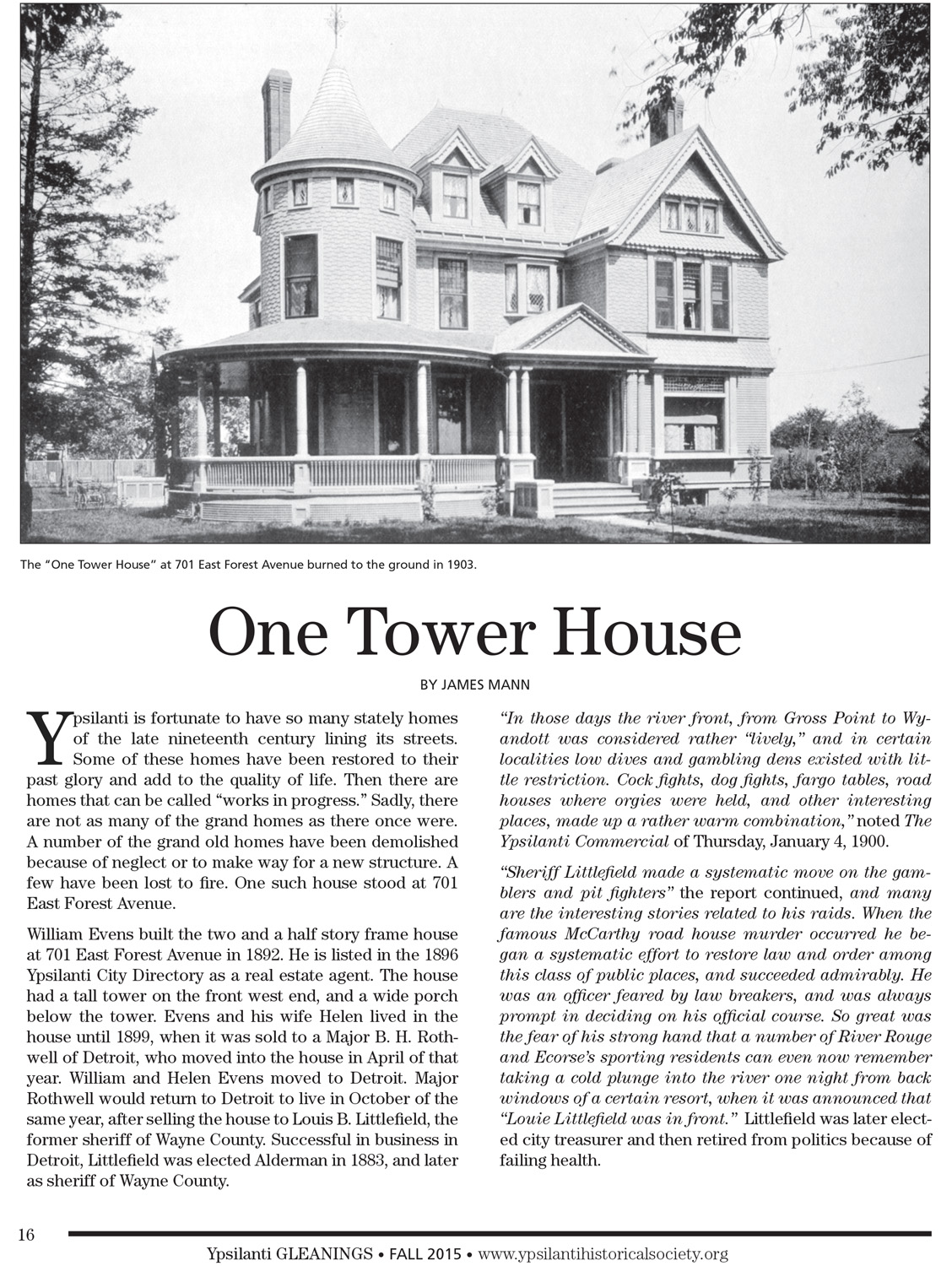
It was Ross who soon after turned the house into apartments. The city purchased the house from her estate for $44,000 on May 24, 1966. Today the house at 220 North Huron houses the museum and archives.

Memories of the "Early Depot Town"

Published In:
Ypsilanti Gleanings, August 2000,
August 2000
Original Images:


Author: Joseph H. Thompson

I have been asked a number of times to give my impression of the Depot section just after 1900.

I was born on Maple Street very close to this area so I think I have a pretty good idea of the business section and some of the merchants and their activities in this part of the city. The east side had many names: The East Side, Depot Town, Cross Street, Down Town as opposed to Up-Town.

I hope that you will pardon me if I begin with the business my parents operated on the corner of River and Cross Streets. It was known as the “Thompson Building”. My grandfather, O.E. Thompson, my father, Benjamin Thompson, my uncle, Edward Thompson, and my uncle, John Thompson were very busy in the manufacturing of agricultural implements; root cutters, grass seeders, kraut and slaw cutters, and later, porch swings. They employed about 40 men. They also ran a retail business selling coal, building supplies, carriages and wagons, paint and wall paper-at one time sold over 200 bicycles in one year. They had the agency for the Nichols and Shepherd threshing engines that were made in Battle Creek. I recall that they had a crew of paper hangers and painters that were busy in the city in that line of work.

In the Thompson Building there was also a tailor by the name of Otto Biske that made hand-made clothes for many of the people who could afford it. Right next to Mr. Biske's tailor shop was the city fire department where they operated one horse, and a couple of firemen who slept up-stairs over the fire equipment. During the off hours Tommy Wilkinson operated this horse in picking up the refuse on the Depot streets. (You know they had horses in those days.) And up on the top of the building was a large bell that would ring and the number of strokes on the bell would tell you what location in town the fire was burning or being extinguished.

Across the street was the Michigan Central Depot with all its busy trains coming and going and baggage wagons and hacks calling out for the Hawkins House and Occidental Hotel, a couple of baggage wagons that were handling the baggage and sample trunks that the salesmen used in selling their wares. The Depot at that time was a two-story building and a fire burned off the top of it and they reduced it to one floor. On that Michigan Central they had one train they called the “paper train” that left Detroit at 2 o'clock at night and took the newspapers all the way up the line from the Detroit publishers. Then they had a train they called “the blind baggage” which had one coach on the rear with holes where the guardians could poke their guns out if it was held up. It carried the money from Detroit to Chicago. Then there was a car on that train they called the “silk car” that carried silk in bales that was all made up in fabric. The Depot was so busy that it was really a nice exciting place to go as kids. Madison Parsons called out the trains-“Train going west, Ann Arbor, Jackson, Battle Creek, Kalamazoo” etc. Tommy Thompson in a uniform sold tickets and George Oberst was a baggageman. That was a very big part of the traveling in those days.

Across the tracks was the freight depot where horse-drawn drays hauled all the freight that came in box cars and shipped out all of the manufactured products for Ypsilanti including the Penninsula Paper Company and other factories that were doing pretty well. The train stopped for water there and the gardens next to the depot were something to behold. Mr. John Laidlaw, a Scotch gardener, was known all up and down the line for his display of flowers and he would build huge arrangements out of flowers and plants like the Niagara Falls and the battleship, Maine and the head boys got on the trains and gave the ladies little bouquets when they stopped in Ypsilanti.

Up the tracks a little farther from the greenhouse were the stock-yards where once a week they shipped livestock in cattle cars. The drovers-well, I remember Mr. Farnsby Horner and Dick Spencer would buy this livestock and then have it brought to the stock yards once a week where they shipped it out.

To come back to East Cross Street-on the corner across the tracks was a hotel called the Neat House, as I remember the first name on it. Then it was changed to the Lewis House. Then a fellow came down from Michigan Center named Dad Yates who opened a tavern and did a thriving business. Oliver Westfall afterwards had the hotel and it had a bar downstairs and sleeping rooms upstairs for maybe 15 or 20 people. Next to this hotel was a drug store that was operated by Robert Kilian and in the drug store was a jewelry repair out-fit run by Mr. E.N. Colby, where they cleaned watches and sold small articles of jewelry. Kilian had a wonderful soda fountain and the kids all went in there when they had the money to buy one. Next door was Clark and House's grocery and later the store was operated by Mr. H.A. Palmer as a hardware store. The next store, going west, was a meat market run by Mr. Charlie Fairchilds and his wife, Lilly, and next to that was the Robert's House, another bar with rooms upstairs, Just beyond that was the Ypsilanti Reed Furniture Company that moved out from Detroit where it was known as the Phoenix Reed Furniture Company. They employed probably 35 to 40 men making reed furniture which was very popular in those days and they stayed for a number of years and finally moved to Jackson, Michigan where they got prison labor for 50$ pH a day. That was the end of the Ypsilanti Reed Furniture. On the corner west of there was a hardware store operated by Whitford and Simmons; Theodore Whitford and Mr. Cal Simmons. They had a tin shop in the back room and in their spare time they made all sorts of tin utensils and eaves-troughs and down-spouts and all that stuff that was made by hand in those days.

That Follett House had quite a history but I never recall when it was a hotel. It was a factory from the time that I remember.

Across the street west of the hardware was the Deubel Mill where they ground up wheat and made flour. It was run by water power from the Huron River with a race that ran north to the dam near Forest Avenue. Up the race a little ways was a saw mill that Mr. H.R. Scovill operated with his partner, George Follmor. The farmers brought in their logs and they were dumped into the race and floated down until the mill was ready to saw them up into lumber. Frog Island across from the race was just full of lumber piles of all different kinds and descriptions. Of course, it was all delivered by horses with immense drays. Up the race a little farther was a sash and door mill that was operated by Scovill and across the river was the Hay and Todd Manufacturing Company or the Ypsilanti Underwear Company that was also run by water power. Just think-that dam operated water power for the woolen mill, for the sash and door, for the Scovill log mill, and for the Deubel Flour Mill. Quite a lot of power came from the Huron River.

On Forest Avenue across from the woolen mill, was a tannery that Mr. Holland ran. He would buy hides from the farmers and tan them into leather. This was quite an operation. He also bought junk. Us kids used to sell him all the metal we could find around and he was a very nice old man as I can remember.

On Forest Avenue, up a little farther on River Street was a malt house run by Mr. Fred Swain. They converted barley into malt that was sold to extensive brewery operations around like Forrester's and like the ones in Ann Arbor and Manchester. That seemed to be a part of the brewing that was very essential in making beer.

Let's go back across the river now on the South side of Cross-Street. The first building that I remember there was a law office where lawyer Lee M. Brown held forth. He has the attorney for all the Depot people that needed to go to law. Next to that law office, George W. Hayes had a grocery. And East of that grocery was John Engal Cartage and Coal office behind which he had an extensive barn and owned a number of teams of horses and drays that did the hauling around the Depot section. A junk dealer, Mr. Louie Cramer, was quite an operator. He had a little store and bought all the junk that was available at that time.

Next to Mr. Cramer's place of business was a cigar store that was operated by Mr. Chris Duress. They called him “Doc”, for he concocted a remedy that he claimed would restore lost manhood. He filled his window one day with this remedy and the sun came through the window pretty bright and the bottles exploded and blew out the front windows so I guess he did away with his remedy after that experience. Tommy Duffy had a shoe repair shop right next door and took care of all the people's wants repairing their shoes.

Now we'll go up Cross Street a little bit farther east. A man by the name of Fremont Paterson had a store which was a bakery and candy store. He was also an inventor. He invented what they called a unicycle. It was a big, tall wheel and he was suspended in the center of it. I saw him come down Cross Street hill and wreck it one day and that was the last we ever heard of the unicycle. Charley Smith had a meat market next door. I guess in those days they called it a butcher shop, and outside of the city they had a slaughter house where the cattle were killed and then brought in and sold at retail. Joel Grieve had a bakery next door and I used to deliver for him on Saturdays. When we came back at night what bread we had left we fed the horse. Davis and Company had a grocery and drygoods store which did an extensive business. Across the alley A.A. Bedell had a shoe store and next was the Justice of the Peace office where they held trials and Squire Beach was, as I remember, the judge and following him was Frank Joslin. Upstairs over these two stores was the Maccabee Hall and it used to be called the Masonic Hall but they moved up town and the Maccabees took it over. Peter Cranson had a barber shop next door and Clyde Roe a restaurant next to him. There was next door what the people called a “horse exchange”. It was where a bunch of gamblers came out from Detroit every day on the Michigan Central and it was what they called “off-track betting”. Large black-boards lined the halls and the race results came in from around the country by wire and these men would bet the same as they do today at the horse races only there weren't any horses in sight. That place was run by Warren Lewis and it was very thriving for number of years until George Burke was elected prosecutor and he closed it up. Upstairs over the horse exchange was a house of ill-repute. “Ma” Bush was the landlady and of course that completed the business section in that neighborhood.

Nick Max had a saloon adjacent and Dick Wilbur operated a cigar store on the corner which is now removed. It was hit by a train and it still shows the scars of where the train struck the building. Later, on that corner, there was a food counter and I remember Mr. Bicraft, where you could go to get a sandwich and a cup of coffee. Down River Street, a ways south, was a foundry and machine shop where they made flour mill machinery. Mr. Charles Ferrier and Mr. George Walterhouse operated this. Next to them was a blacksmith shop run by Otto Rohn. Of course, all the horses had to be shod in those days and this was one place they could take them. Now, on the southeast corner of River and Michigan was the Ypsilanti Electric Company that furnished electric lights for the city in their homes and business, only there was no power generated at that time. It only ran at night because there wasn't any use of electricity in the day time. There were two plants in Ypsilanti-one that furnished the city lights and the water works and the other building furnished the lights for the homes. I remember our home at 108 Maple Street was the first one that was wired in Ypsilanti because it was the closest one to the plant. George Essinger came in with his wire. None of the wires were concealed. They just ran up the walls and across the ceilings except that they took the gas fixtures and rewired them for electric which were quite ornamental. Later this electric plant was sold to Edison Company.

I've been told by two interesting people of those days about a couple of sales that were made at the Depot. One was when Denny Doyle sold the Follett House. It seems that business had fallen off quite a lot. Denny wanted to sell the place so he heard about a fellow by the name of Mathias who was looking for a tavern so he invited him to Ypsilanti to take a look at the Follett House.

Denny was a little bit unscrupulous in his business actions but he got a group of fellows to go to Ann Arbor with suit cases and another group to go down to Wayne and when the Michigan Central train came in these fellows flocked into the Follett House to register and stay over night. Mathias was sitting in the lobby and he looked over the crowd and just then the train came in from the other way and these fellows he had sent to Wayne came in. Well, the bar was doing business and the barber shop was doing business and Mathias was mesmerized by the amount of business he anticipated so he bought the place; and didn't they sell him another place up in the Thompson Building for an overflow of his patrons. Well, he paid his money and he owned the hotel and Doyle was gone.

Another incident that happened that had a little humor to it was when they had the fiftieth anniversary and the celebration was held at the Depot. They had an arch over the road that was made of lattice and up on the top of the arch they had a figure of the Goddess of Liberty, which was a manikin bust that they borrowed from some milliner. Well, they had a speaker-I don't know, a congressman or somebody, come here to make the speech for the fiftieth anniversary. They had this bust up on top of the arch with a shroud over it and at a critical time in his speech they were to pull the rope and that would take the shroud off the bust. But, in the night some wag crawled up on there and with his jackknife cut a hole in the mouth of the Goddess of Liberty and inserted about a 7-inch cigar so at the critical moment they pulled off the shroud and there was the Goddess of Liberty, instead of looking fresh and sweet as she should, she had this great big cigar in her mouth and it brought down the house. Well-so much for that.

There was quite an interesting thing that happened at the Depot. Mr. Shelly B. Hutchinson had a shoe store there at one time and in visiting a friend of his over in Jackson he noticed that he had a sales gimmick where he gave each customer a coupon and on Saturday night they would have a drawing and somebody would get a nice piece of jewelry. Well, that started Mr. Hutchinson thinking about trading stamps and he developed the whole thing in the Depot section of Ypsilanti. And that is the Hutchinson of the S & H Trading Stamps. He built a beautiful home on River Street that still stands, which is kind of a monument of his great success in the trading stamp business. Other things that Mr. Hutchinson got into didn't pan out so well. He started a newspaper in Detroit called the United States Daily that failed and he started a cereal factory something like the Battle Creek cereal over at the Depot and that didn't do too well.

Did you know a horse-drawn street car operated between Depot Town and Up Town? It was driven by Ruben Cole and went west on Cross Street to Washington and then south to Harriett Street. I recall my mother placing me on a seat with a quantity of sewing material and patterns, and Mrs. Frank Showerman removing me, at her home on South Washington Street. They never turned the car around, simply changed the horse to the other end.

Well, I hope I haven't made too many mistakes in this little discourse and I hope some of you people find it interesting about the early days of Depot Town.

Dawson Letter

Published In:
Ypsilanti Gleanings, October 1986,
October 1986
Original Images:

We have received many articles of information about the Ypsilanti Post Office and other items from the files of the late Postmaster, Mr. Wesley Dawson who served 1945-1964. This material was donated by Mr. John Dawson, son of Wesley Dawson.

The following letter was sent to a neighbor of Martin Dawson.

June 2, 1913

My Dear Madam:

Mr. Martin Dawson, was in my office this morning and complained of your hitting him in the face. Under the law he could have had you arrested, and a fine or jail sentence could have been imposed upon you by the Court. Mr. Dawson however, on account of your age was good enough to overlook this insult and injury, but instead asked me to write and tell you what your rights are, and I am accordingly sending you this letter.

In regards to the line about which you claim a mistake was made, would say it seems Mr. Dawson, Mr. Batchelder, Mr. Stevens and Mr. Pettitt had it surveyed and you now have all the property you are entitled to have. Furthermore you have no right to hit people or trespass on their property, or to throw stones, glass or anything else upon their property. You have no right to call folks liars and other names unless it is so. In this case you could not prove that any one took any property from you hence it is unjust and unlawful to attribute to any of your neighbors or Mr. Dawson such names as thief and lair. Mr. Dawson will not stand for this treatment always and has instructed me to say that unless you stop annoying your neighbors and particularly Mr. Dawson and his family, and quit calling them names, he will have you brought into Court and give you a chance to prove what you say. I trust this letter will be received in the spirit in which it is written and that you will decide to be good to your neighbors, stop abusing them or calling them names and that peace may reign.

Your truly,
Martin B. Stadtmiller
Municipal Justice

Mr. Martin Dawson about whom this letter is addressed was the Grandfather of John Dawson who lived on Grant Street. The property in question is at 213-215 W. Stadtmiller was the City's Municipal Justice and was the father of local citizens, Mrs. Martha Walton and Mr. Bennett Stadtmiller. He was the first lawyer to hold the Office of Justice of Peace in the City, an Office he held for fourteen years until his untimely death in 1924.

Chronology 1888

Published In:
Ypsilanti Gleanings, February 1986,
February 1986
Original Images:


January 5

H. W. Glover bade goodbye to Ypsilanti and departed for San Francisco to manage the Pacific Coast department of the dress stay business.

January 6

"some talk of Ypsilanti losing the flourishing Business College of Prof. Cleary. Toledo Capitalist's slipped in and agreed to erect the building that is planned...but they did not get the prize..." Ypsilanti will have the new building.

Martin Cremer appointed Postmaster.

Died: December 26th at the residence of S. P. Clark, Mrs. Amanda P. Judd in her 91st year. She was born July 2, 1797 in Wells, Rutland County, Vermont. She was married in 1817 to Capt. Judd, he died in 1860. They came to Washtenaw County in 1831. A very devout Baptist for more than 60 years.

On December 31st Mr. & Mrs. E. M. Comstock celebrated their 25th Wedding Anniversary.

Miss Frances Stewart's Commission as Post Mistress expires tomorrow. The great question of who will be appointed. F. P. Bogardus and Martin Cremer have been the most possible-and it has been answered President Cleveland appointed Martin Cremer.

January 13

John W. Nanry is the heaviest individual Tax payer in Superior Township.

AD: Alban & Johnson will present with every Cash Sale of boy's suits or overcoat amounting to $5.00 a beautiful sleigh, strong enough for large boys and fancy enough for small ones.

January 19

Died: Mr. David Moore at his residence on Perrin St., 93rd year. He came to Superior in 1830 and moved into town 10 years ago.

January 21

Died: Frederick Andrew, age 80.

January 20

William Lambie, our Farmer Poet, sent a Birthday greeting in poetry to John Greenleaf Whittier and received the following from the best American Post:
Dear Friend:
I heartily thank thee and am thy sincere friend.
John G. Whittier.

February 10

The work of Art exhibited at the Post Office by Winsor McKay, Prof., of drawing at Cleary College is a great credit to the young man's artistic ability.

Mack & Mack have added to their very complete equipment as Funeral Directors, an elegant funeral car, purchased from James Cunningham & Co., of Rochester, New York. It is one of their best makes and is really a work of art.

Robert C. Lambie of Superior received a very severe injury Wednesday while sawing wood at the farm of F.H. Hiscock. While in the act of shoving the saw, his hand slipped, falling on the buzz saw and cutting his hand severely. It will be several months before he will regain the use of his hand.

February 17

Venerable Robert Campbell died Tuesday night at the residence of his daughter, Mrs. William Lambie in the 86th year of his age. The Lambie home was on North Street across from the Catholic Cemetery.

Rolland Fletcher has been summoned to the bedside of his brother Addison Fletcher who has been spending the Winter in the South for his health, growing rapidly worse. He started for home but failed to get farther than Alton, Illinois.

March 2

Died: Mrs. Mary A. Post, relative of the late William Post, last week Monday at her home on Forest Avenue.

Died: Rebecca Cutter, born April 25, 1817, married Daniel Pierce, October 1, 1834. Came to Michigan 1839.

Saline Road Toll Gate discontinued.

City to have house mail delivery with 4 carriers and one substitute. The carriers are William Eddy, Walter Fuller, H.R. Scovill and Sam Fletcher.

Julia Marlowe appeared at the Ypsilanti Opera House. No more thoroughly delightful performance has ever been given here.

March 15

Died: Mrs. Franklin J. Fletcher of cancer of the liver.

March 23

G. E. Gooding, Henry Ewing, Joe Corbitt, Jas. Delaforce, B.F. Gooding and John Ketchum of the 4th Michigan Cavalry who went to the Front in 1862, met at the residence of B.F. Gooding on Marth 15th bringing their wives with them, to renew old acquaintances and have a jolly time, Ketchum was discharged for a wound in March, 1863, the rest came home with their Regiment in 1865.

March 30

Shelly Hutchinson, formerly a pupil at Cleary College has accepted a position with a prominent Grand Rapids firm.

April 6

Married last Monday, April 2nd, by Rev., Lowry, Aaron E. Holmes and Nora Goodell both of Cherry Hill.

April 13

Rev., Father DeBever has purchased 14 acres on North River Street at Clark Road for $1,400.00.

May 18

Married At St. Luke Church, May 15, 1888 by the Rev., William Galpin of Hobart Hall, University of Michigan, Louis Lyman Burton of Detroit and Francis H. Cheever of Ypsilanti.

May 25

E. E. Furgason will be Principal of the School at Sand Beach next year. This School has seven departments

June 8

Winsor McKay, assisted by a quartet of Musicians of this City will give an entertainment at Grange Hall, Belleville, on Tuesday.

June 29

AD: Lowest prices and Best Grades of Boots and Shoes at L.M. Duggan's-Cash Shoe Store-Gilbert Block at the Depot-23 East Cross Street.

July 6

The Holmes Brick yard, some two miles south of town has been leased by Messers. Warren and Frost of Tuscola County. They have their first kiln of brick burned and ready for use.

Dr. Thomas Shaw of Chelsea since 1870 has decided to move to Ypsilanti.

Ypsilanti now boasts of twenty-four practicing physicians.

Dr. Hueston has purchased the Swift home on North Huron Street and is engaged in improving and modernizing it.

Barnum & Bailey's new Barnum & London Circus will show here July 18.

Half rates will be given on the Michigan Railroads to person going to Bay View Summer resort from July 16th to 25th. Round trip tickets from Ypsilanti will cost $9.30. Bay View is becoming one of the most popular resorts in the country.

The Hotel and boarding accommodations are ample and prices only $5.00 and $10.00 a week. Over 100 cottages will be built this year.

Winsor McKay, leaves tomorrow for a month's visit at his home in Stanton.

July 12

The new brick school building in the 1st Ward is assuming attractive proportion, 34 × 60 feet with 14 foot ceilings.

July 13

All kinds of Fresh and Salt Meats at bottom prices. F.C. Banghart, South side of Congress (Michigan Ave.).

Buy a Buggy cheap at McPherson & Scott. (Alexander McPherson and Willis E. Scott) we are selling Buggies at cost to make room.

1st Block on Washington Street.

July 17

Died: Abby Marie Cheever inher 90th year. Born December 3, 1798. The widow of Rev., E. Cheever, Presbyterrian Pastor-1850–1854.

August 3

Ann Arbor capitalist talk of building a street railroad there.

C.W. Mead, M.D., formerly of Dundee, has moved his family here into the Salyer house at the north end of Washington Street.

About 300 of our colored citizens helped celebrate Emancipation Day at Jackson.

Party consisting of Mr. & Mrs. Willis Potter, Mr. & Mrs. Galloway of East Milan, Mr. & Mrs. S.P. Ballard, and Mrs. Cooper of St. Louis, Hunt & Slocum with Messers, Bryant, Garisin, Branton and Dickerson, visited D.W. Potter on Sunday.

Party consisting of Mrs. F.H. Ballard, Mrs. Albert Draper, Mrs. Whitney Voohees—?

August 10

The old Tannery building near Congress at bridge has been sold to Joseph DeMosh who will turn it into a livery stable. It is a 3 story brick building.

August 17

Norval Hawkins of East Saginaw is visiting his parents Mr. & Mrs. W.H. Hawkins.

August 24

E.E. Ferguson of this City and Miss Agnes Van Norman of Brockway, Michigan were married at the bride's home last Wednesday.

August 31

Rev. M.S. Woodruff of Big Rapids has accepted a call to the St. Luke's Episcopal Church of this City. His duties as Rector will begin about September 15th.

The people of the Congregational Church have been with out a Pastor since Rev., M.N. Fairfield resigned July 1st. Have extended a call to Rev. Beal of Whitehall, Michigan.

September 13

Archie Foster, the colored boy who graduated at the Normal last year, goes this week to take the Principalship of a School at Hope, Arkansas. A promising young man.

September 14

A large number present at the dedication of the new Masonic Hall in the Bank Building. (New Savings Bank S.E. corner of Michigan Avenue and Huron).

Mr. Jewett, 9 N. Summitt Street has razed the old house to the ground and is building a fine new modern residence.

W.E. Ballard and brother will sell in September, 26 acres on the farm one fourth mile south and one mile west of Willis station, a large lot of farm property.

September 20

Mr. Miller, the new Pastor of the African M.E. Church is a full blooded Mohawk Indian with an African wife.

September 21

15,000 people at the Fair yesterday, at the Fair Grounds on Congress Street.

September 28

Died: Mrs. J. W. Babbitt

New Cleary College in process of construction.

October 12

Will Ballard will teach the winter term at Allen School.

October 19

At about 8:15 Tuesday morning, one of a gang of Boilers in the Ypsilanti Paper Company's Lowell plant exploded, throwing the other 3 boilers from their foundation and utterly demolishing the boiler room. Jacob Slawson was in the boiler room and killed instantly. Frank Sinkulki (Sinkule), the engineer was injured.

C.H. Morse, the Boston Poultry buyer is here to buy poultry. Last year he shipped nearly 100 tons of live poultry from Ypsilanti.

Last Thursday, the Veterans of the 20th Michigan Infantry, about 150 strong, gathered in Ypsilanti being their twenty third reunion.

November 2

I offer $25.00 reward for testimony which will lead to the arrest and conviction of the party who tore down and ruined my stone horse block on the evening of October 31 (Halloween).

The Follett House was sold last Friday by Mr. A.R. Nowlin to Mr. Thomas Mathias of Owosso. The Manager will be George Morman.

November 8

Benjamin Harrison elected President of the United States and Levi P. Morton, Vice President.

November 9

Died: Samuel Casey of Superior, October 28, age 88.

November 20

"After a sickness of over three years, Addison Fletcher, Jr., died at his residence in this City, November 20, 1888, age 36 years. He died of Neurasthemia".

November 23

Messers. Fred Lamb, Guy Davis and Will Kishlar have purchased the dry goods store stock of H.P. Glover. Mr. Glover who is half owner of the Dress Stay Manufacturing Company and will devote his entire time to that business.

Andrew Fisher sold sixteen acres of land to Jesse Thorne for $800.00.

November 29

Governor Luci visited the Normal and he spoke to an enthusiastic audience of students.

December 13

Starkweather Memorial Chapel at Highland Cemetery is now practically completed. The windows which have recently been put in, are perhaps the richest of anything in that line in the County. The two principal ones on the North and South are Memorials. The inscription are in twin circles, those on the North being:

In Memory of Ira M. Weed and Caroline, his wife 1864–1871

One on the South:

In Memory of John D. Pierce-D.D. 1800–1882

December 21

THE YPSILANTI COMMERCIAL 1888

Fred Prease came home from Lewanee, Texas for the vacation. He is attending the University there. D. L. Quirk, Jr., a student at the same institution is apending the vacation with his parents.

AD: 2000 pounds Mixed and fancy candies-selected expressly for the Holiday trade. Washburn's-29 Congress Street (Michigan Avenue) South side.

Syndicate content